
JournalCommutingBento
Why is gas so expensive in California? The simple truth, and an easy way to stop feeding the tank
- Written byMahmoud Alsammar, Owner, Cyber City
- Fact-checked byRyan Alali · Reviewed
The 30-second version
The answer
Gas is so expensive in California because several layers stack on the same gallon: a state excise tax of 63.4 cents a gallon, about 49 cents of cap-and-trade and Low Carbon Fuel Standard costs, a cleaner special blend that only a few refineries make, and a market that is isolated from the rest of the country. On October 16, 2026, AAA had California at $6.2180 and Orange County at $6.2012, against a national average of $4.3271.
Orange County regular
$6.2012
a gallon (AAA, Oct 16, 2026)
California average
$6.2180
a gallon (AAA)
National average
$4.3271
a gallon (AAA)
State excise tax
63.4
¢ a gallon from July 1, 2026 (CDTFA)
Cap-and-trade + LCFS
49
¢ a gallon, about (CEC, August 2026)
Why is gas so expensive in California? The pump hits $90 and the tank still isn’t full.
In one lineIt’s not one thing. It’s a stack of layers on the same gallon, and you pay every layer every time you fill up.
You squeeze the handle. The numbers spin like a slot machine that only takes money. Sixty. Seventy. Eighty. Ninety. Click. And the same question you ask every week: why is gas so expensive in California?
The short answer to “why is gas so expensive in California?”: it’s not one thing. It’s a stack of things on the same gallon, and you pay every layer every time you fill up. This guide pulls the stack apart with the official numbers, shows what it costs you in Orange County, then gives you the moves that lower the bill. The last one is the big one. You can’t change the price of gas. You can change how often you buy it.
You can’t change the price of gas. You can change how often you buy it.
Why is gas so expensive in California right now? The numbers that hurt
In one lineCalifornia is number one: $6.2180 a gallon on October 16, against a national average of $4.3271.
On October 16, 2026, AAA put regular gas at $6.2180 a gallon across California and $6.2012 in Orange County.1 The national average that same day: $4.3271.2 The U.S. Energy Information Administration had California at $6.104 for the week of October 12, against $4.331 for the whole country.3
California was the most expensive state on AAA’s map that day, ahead of Hawaii at $5.6380.2 We’re not just high. We’re number one. That’s the gap behind every “why is gas so expensive in California?” at the pump.
What that means at your pump
Our math, so you can check it. A 15-gallon fill-up in Orange County costs about $93.02. The same 15 gallons at the national average: about $64.91.12 That’s $28.11 more, every single time the light comes on.
| Item | Value |
|---|---|
| Orange County | $93.02 |
| National average | $64.91 |
15 gallons at AAA’s Orange County and national averages, October 16, 2026. Source1
Over a year? AAA’s ownership study assumes 15,000 miles a year.14 At 25 mpg, that’s 600 gallons. In Orange County, about $3,721. At the national average, about $2,596. Same car, same miles, roughly $1,124 more a year, just for living here.12
The number that matters
$1,124
more a year: same car, same 15,000 miles at 25 mpg, just for buying gas in Orange County instead of at the national average (our math).1214
And it went up fast. A year ago, California regular was $4.6498. Today it is $6.2180, a jump of about $1.57 a gallon.1 Diesel is worse: $8.4898, a new state record on AAA’s page.1

So why is gas so expensive in California? The official answer
In one lineCrude is the biggest line, but four layers make California different: the excise tax, climate fees, a special blend and an island market.
To answer “why is gas so expensive in California,” start where the state does. The California Energy Commission publishes an estimate of where every dollar of a gallon goes. Its latest month is August 2026, when the average California gallon came to about $5.46.4 Here is how that gallon broke down, in the CEC’s own categories:
- Crude oil: about $2.28.4
- Refining margin: about $1.05. That is the refiners’ costs and profit.4
- Distribution and marketing: about 68 cents. Trucks, stations and their profit.4
- State excise tax: 63.4 cents.45
- Cap-and-trade: about 26 cents.4
- Low Carbon Fuel Standard: about 23 cents.4
- Federal excise tax: 18.4 cents.4
- State and local sales tax: about 12 cents.4
- Underground storage tank fee: 2 cents.4
Four layers make California different.
| Layer | What it adds | How it works |
|---|---|---|
| State excise tax | 63.4¢ a gallon | Moves every July with the California Consumer Price Index5 |
| Cap-and-trade + Low Carbon Fuel Standard | About 49¢ a gallon | State climate and clean-air programs: about 7 to 10% of a gallon7 |
| The special California blend | Typically 10 to 15¢ more to make | Cleaner-burning gasoline, and summer blend for longer than the rest of the country6 |
| An island market | Spikes after refinery outages | Few refineries make the blend, and imports take three to four weeks by ship68 |
1. The state excise tax
Go deeperHow the excise tax moves, and the 96 cents of taxes and fees
California’s gas excise tax went from 61.2 to 63.4 cents a gallon on July 1, 2026.5 It moves every July with the California Consumer Price Index, a rule state law sets and voters kept in 2018 when they rejected Proposition 6.5 The federal tax, by comparison, is 18.4 cents and hasn’t gone up since 1993.47 Add sales tax and the storage tank fee, and taxes and fees come to roughly 96 cents of every California gallon, by the CEC’s August numbers (our sum).4
2. Cap-and-trade and the Low Carbon Fuel Standard
These are California’s climate and clean-air programs, run by the California Air Resources Board. The CEC counts their cost as part of what you pay at the pump. In August 2026 the CEC estimated about 26 cents for cap-and-trade and about 23 cents for the Low Carbon Fuel Standard, close to 49 cents together.4 The CEC’s FAQ puts the clean air and climate programs at about 7 to 10% of the total cost of a California gallon.7
3. The special California blend, and the summer blend
California requires its own cleaner-burning gasoline. The CEC says that blend costs more to make, typically 10 to 15 cents a gallon more than the U.S. average.6 Before the weather heats up, refiners switch to a summer blend that cuts smog, and the CEC notes the state uses summer-blend gasoline for longer than the rest of the country. Summer blend costs more to produce too.67
4. An island market with few refineries
The CEC calls California’s fuel market isolated, and says most of our transportation fuel is refined in-state.7 The EIA adds that relatively few refineries make California’s unique blend, and that they must run near full capacity to meet demand.8 When one has trouble, there is little slack. Imports come by ship, and the CEC says those usually take three to four weeks to arrive.6 So when an unplanned refinery outage hits, prices spike and stay up until the tanker shows.68 If you’ve ever asked “why is gas so expensive in California this week?” after a refinery outage, that’s the reason.
Why is gas so expensive in California this year? Crude oil
The biggest single line is still crude oil, and crude trades at a world price. The CEC says the conflict in Iran that started on February 28, 2026, disrupted shipping in the Strait of Hormuz, a chokepoint for roughly 20% of the world’s daily oil supply, and that California sourced about 17% of its crude through it before the conflict.7 Its rule of thumb: every $10 rise in a barrel of crude adds roughly 24 cents a gallon at the pump.7 Crude went from about $1.71 of a California gallon in August 2025 to about $2.28 in August 2026.4
| Item | Value |
|---|---|
| August 2025 | $1.71 |
| August 2026 | $2.28 |
Source4
The CEC’s rule of thumb
24 cents
a gallon: roughly what every $10 rise in a barrel of crude adds at the pump.7
So why is gas so expensive in California? Some layers are fixed by law, some swing with the world, and none of them are yours to control. The rest of this guide is about the part you do control.
Picture a month where the tank just lasts
In one lineTwo levers: burn less gas per mile, and drive fewer gas miles. The second one is worth a lot more.
Now imagine the opposite. You fill up, and two weeks later the needle is still past half. The grocery run, the coffee, the gym: none of them touched the car. You roll past the station and don’t even look at the sign. Why is gas so expensive in California? You stop caring.
That month comes down to two levers: burn less gas per mile, and drive fewer gas miles. The first is free and worth a few percent. The second is worth a lot more.
How to save money on gas: the moves that actually work
In one lineNo gadgets, just physics: drive smoothly, slow down, fix your tires and group your errands. You might save 10 or 15%.
The answer to “why is gas so expensive in California?” won’t lower your bill. These moves will. They come from fueleconomy.gov, the federal site run by the Department of Energy and the EPA. No miracle gadgets. Just physics.
Drive like you’re not late
Speeding, hard acceleration and hard braking waste gas. Fueleconomy.gov says aggressive driving can lower your mileage by 15 to 30% at highway speeds and 10 to 40% in stop-and-go traffic.9 On a $93 tank, every 10% you save is about $9.30 back (our math).
Ease off above 50 mph
Mileage drops fast above 50 mph. Fueleconomy.gov says each 5 mph over 50 is like paying an extra 30 cents a gallon, using a $4.33 pump price.9 At Orange County’s $6.20, that same loss is worth about 43 cents a gallon (our math).1
Stop idling, and lose the roof box
Idling burns about a quarter to half a gallon an hour, depending on the engine and the A/C.9 A roof cargo box can cut fuel economy by 2 to 8% in the city and 6 to 17% on the highway, and every extra 100 pounds in the car costs about 1%.9 Empty the trunk.
Check your tires and your oil
Under-inflated tires cost you about 0.2% of your mileage for every 1 psi drop. Keeping them at the right pressure improves mileage by about 0.6% on average and up to 3% in some cases.10 Using the oil grade your maker recommends can add another 1 to 2%.10 The right pressure is on the sticker inside your driver’s door, not on the tire.
Free, and takes two minutes
The right tire pressure is on the sticker inside your driver’s door, not on the tire. Every 1 psi under it costs about 0.2% of your mileage.10
Shop around, and combine your trips
The CEC’s market office tells drivers to shop around, and notes that all gasoline sold in California, branded or not, meets the state’s specifications.7 AAA’s metro list on October 16 ran from $5.9467 in El Centro to $6.4097 in San Luis Obispo, so the station matters.1 And plan your errands: fueleconomy.gov says several short trips from a cold start can use twice as much fuel as one longer trip covering the same distance.11 Carpooling can cut your weekly fuel cost in half.11
Try it · Your charging setup
How to save on gas this week
00
Pick an answer above.
Sources 7, 9 to 11 · fueleconomy.gov and the CEC
Do all of that and you might save 10 or 15%. Good. But every tip still assumes you’re in the car. The real money is in the trips where you don’t need it at all.
The big lever: stop burning gas on short trips
In one lineYour shortest trips are your most expensive miles. Move them to an e-bike and each one costs about 30 times less.
Here’s what most “how to save on gas” lists skip. More than half of all daily trips in the U.S. were under three miles in 2021, and 28% were under one mile, according to a Department of Energy analysis of data produced for the Bureau of Transportation Statistics.12 Coffee runs. The pharmacy. The school drop-off.
| Item | Value |
|---|---|
| Daily trips under one mile | 28% |
More than half of all daily trips were under three miles. Source12
Short trips are also the worst trips for your engine. It never warms up, and that is exactly when fueleconomy.gov says your car burns the most.11 That’s the hidden answer to “why is gas so expensive in California?” for you: you’re paying $6.20 a gallon to drive your least efficient miles. Move those miles to an electric bike or scooter and the math flips.
Cost per mile: car vs e-bike
Our math, assumptions shown. A car that gets 25 mpg, on Orange County gas at $6.2012, costs about 24.8 cents a mile in fuel alone.1
Go deeperHow we got 0.8 cents a mile for the e-bike
For the e-bike, we assume 20 watt-hours a mile, plus about 15% lost in the charger, our battery guide’s rule. That is a safe, high number: Lectric rates the XP Lite 2’s 375 Wh battery for up to 45 miles, well under 10 Wh a mile on the maker’s own figures.15 California’s average home electricity price was 33.61 cents per kWh in July 2026, per the EIA.13 That gives about 0.8 cents a mile. On Southern California Edison’s tiered plan, the Tier 1 and Tier 2 prices quoted in our e-bike battery guide (30 and 39 cents) put it between 0.7 and 0.9 cents.
So a gas mile costs about 30 times what an electric mile costs. Same trip. Same destination. Roughly 30 times the price.
| Item | Value |
|---|---|
| Car, 25 mpg | 24.8¢ |
| E-bike | 0.8¢ |
25 mpg car on Orange County gas at $6.2012; e-bike at 20 Wh a mile plus 15% charger loss, at 33.61 cents per kWh (source 13). Source1
What that looks like over a year
Take five short errands a week, three miles each way. That’s 30 miles a week, about 1,560 miles a year. In the car: about 62 gallons, roughly $387 in Orange County gas, and up to about twice that once you count the cold-start penalty.111 On an e-bike: about $12 of electricity (our math).13
Now add a commute. A 20-mile round trip, 240 workdays a year, is 4,800 miles. In the car that’s about 192 gallons, or about $1,191 of gas at today’s Orange County price. On an e-bike: about $37 of power (our math).113 Set aside $300 a year for e-bike tires, brakes and battery wear, our calculator’s assumption, and you’re still far ahead.
Try it · Car or e-bike
What would moving my short trips save in a year?
00
Pick an answer above.
Sources 1, 13 and 14 · every assumption shown and yours to change
What if an e-bike lets you sell a second car? AAA puts the cost of owning a new car at $12,863 a year, or $1,071.92 a month.14 Our guide can an e-bike replace a car runs that math, and e-bike commute in Orange County shows how far the daily ride really goes.
E-bike or scooter for the trips that eat your gas?
In one lineBoth kill short trips. An e-bike carries more and goes farther; a scooter is lighter and lives next to your desk.
Both kill short trips. Pick by the trip.
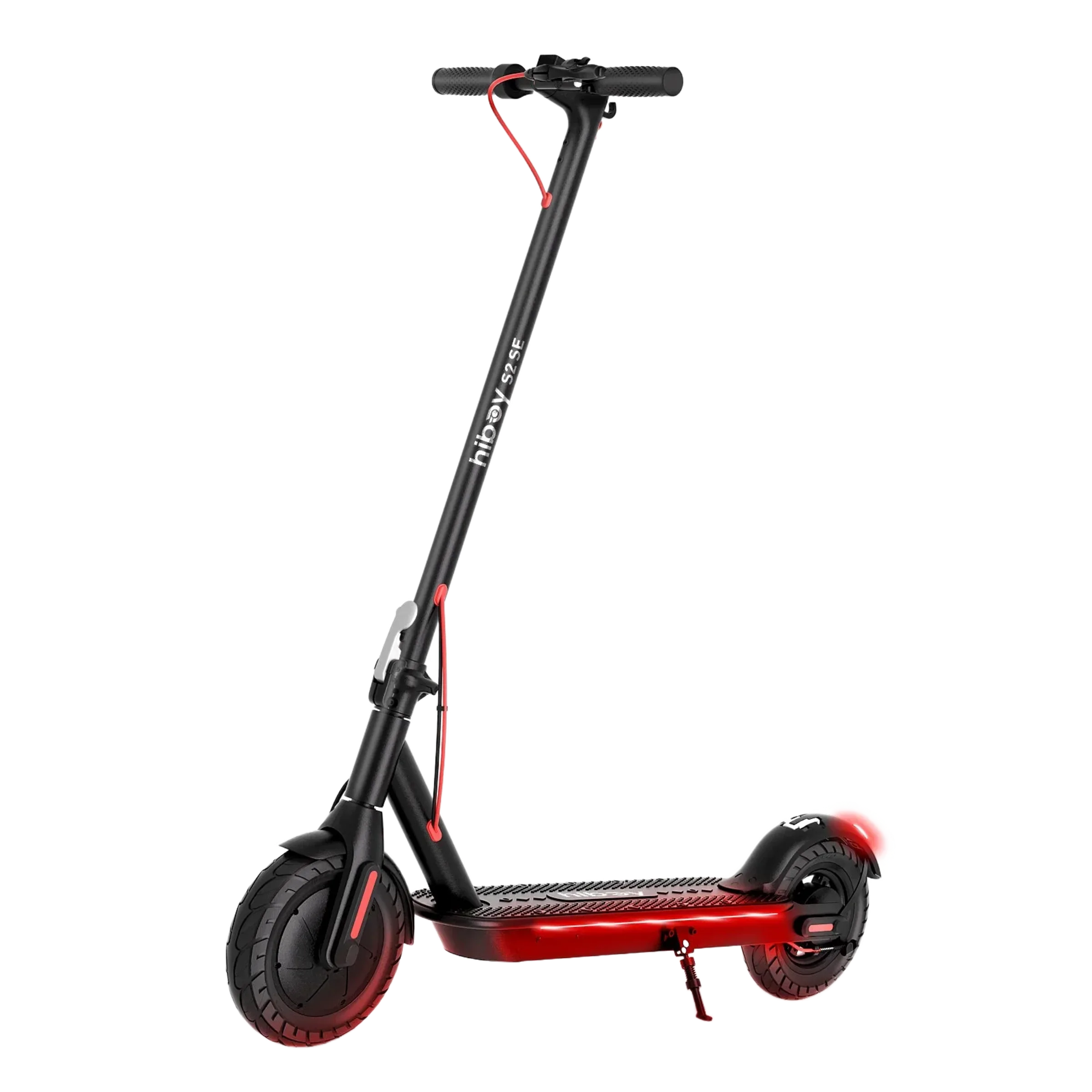
| Spec | Lectric XP Lite 2 (e-bike) | Hiboy S2 SE (scooter) |
|---|---|---|
| Best for | Errands and the commute | The last mile and the quick run |
| Top speed | 20 mph, Class 1 or 2 | 19 mph16 |
| Maker-rated range | Up to 45 miles, or 80 on the long-range battery | Up to 17 miles in ideal conditions16 |
| Weight | 41 pounds, plus the 7-pound battery | 37.8 pounds16 |
| Folds | Yes | In about three seconds16 |
An e-bike for errands and the commute
An e-bike carries more, climbs easier and goes farther. Take the Lectric XP Lite 2: it folds, weighs 41 pounds without its 7-pound battery, tops out at 20 mph as a Class 1 or 2 e-bike, and is rated for up to 45 miles on the standard battery or 80 on the long-range one, with hydraulic disc brakes.15 On a budget? Our cheap electric bike guide shows what to look for under $1,000, and every model we carry is on the e-bikes page.
A scooter for the last mile and the quick run
A scooter is lighter and lives next to your desk. The Hiboy S2 SE has a 350 W motor, a 19 mph top speed, up to 17 miles of maker-rated range in ideal conditions, folds in about three seconds and weighs 37.8 pounds.16 Put its price on our site next to the roughly $387 of gas in that errand example, and see how fast short-trip fuel alone pays for it. We are an authorized Hiboy dealer. Read commuter electric scooter before you choose, and see every model on our electric scooters page.
Whatever you ride, wear a helmet. We carry helmets for every kind of ride.
Try the cheaper mile in Fullerton
In one lineStop paying $6.20 a gallon to drive three miles. Tell us the trips you want off the car and test-ride the fix.
Stop asking why is gas so expensive in California every time you fill up, and stop paying $6.20 a gallon to drive three miles. Cyber City is at 932 W Orangethorpe Ave in Fullerton, open every day from 10 AM to 8 PM. Ask for an e-bike test ride: tell us the trips you want to move off the car, and we call you to set the time.
Spreading the cost out? Easy to own lets you apply for lease-to-own with Acima or Snap, online or in the store. Leasing costs more than the cash price. Questions first? Call (657) 445-7230.
Why is gas so expensive in California? More questions people ask
Why is gas so expensive in California, at $6 a gallon?
Because crude oil, refining, distribution, taxes and the state’s climate programs all stack on the same gallon. In August 2026 the CEC estimated about $2.28 for crude, $1.05 for refining, 68 cents for distribution, 63.4 cents of state excise tax and about 49 cents of cap-and-trade and Low Carbon Fuel Standard costs, plus federal and sales tax.45 The special California blend and an isolated market with few refineries add pressure on top.68
Which state is the most expensive for gas?
California. On October 16, 2026, AAA’s map had California at $6.2180, ahead of Hawaii at $5.6380, Nevada at $5.4161 and Washington at $5.4107.2
Which city has the cheapest gas in California?
Among the metro areas AAA tracks, El Centro was lowest on October 16, 2026, at $5.9467, followed by Yuba City at $5.9814. San Luis Obispo was highest at $6.4097, and Orange County sat at $6.2012.1 Check before you fill up.
What is the highest gas price ever in California?
AAA lists California’s record average for regular at $6.4375, set on June 14, 2022. Diesel set its own record of $8.4898 on October 16, 2026.1
Is gas in California going up to $8 a gallon?
Why is gas going up because of Iran?
Because oil trades at a world price. The CEC says the conflict that began on February 28, 2026, disrupted shipping through the Strait of Hormuz, where roughly 20% of the world’s daily oil supply passed, and that about 17% of California’s crude came through it before the conflict.7
How much is gas when oil is $100 a barrel?
There’s no fixed number, because refining, taxes and distribution sit on top of crude. The CEC’s rule of thumb is that every $10 a barrel adds or removes roughly 24 cents a gallon at the pump.7
Who makes all the money when gas prices go up?
The CEC’s breakdown shows where it goes. Between August 2025 and August 2026, crude went from about $1.71 to $2.28 of a California gallon, the refining margin from about 76 cents to $1.05, and distribution from about 65 to 68 cents. The state excise tax went from 61.2 to 63.4 cents.4
Sources
- AAA gas prices, California: state average regular $6.2180, Orange County $6.2012, year ago $4.6498, record high $6.4375 (June 14, 2022), diesel $8.4898, prices as of October 16, 2026 (read October 17, 2026) (opens in a new tab)
- AAA gas prices, national average $4.3271 and the state map (California $6.2180, Hawaii $5.6380, Nevada $5.4161, Washington $5.4107), prices as of October 16, 2026 (read October 17, 2026) (opens in a new tab)
- U.S. Energy Information Administration, Gasoline and Diesel Fuel Update, week of October 12, 2026: U.S. $4.331, West Coast $5.639, California $6.104 (read October 17, 2026) (opens in a new tab)
- California Energy Commission, Estimated Gasoline Price Breakdown and Margins, with its data file for May 2024 to August 2026, updated October 15, 2026 (read October 17, 2026) (opens in a new tab)
- California Department of Tax and Fee Administration, Special Notice L-1025, “Tax Rates for Motor Vehicle and Diesel Fuels,” June 2026: gasoline excise 63.4 cents a gallon from July 1, 2026 (read October 17, 2026) (opens in a new tab)
- California Energy Commission, Energy Almanac, “California’s Petroleum Market” (read October 17, 2026) (opens in a new tab)
- California Energy Commission, “FAQ California Gas Prices and the Impacts of the Iran War,” updated August 26 and October 13, 2026 (read October 17, 2026) (opens in a new tab)
- U.S. Energy Information Administration, Gasoline explained, “Regional gasoline price differences” (read October 17, 2026) (opens in a new tab)
- U.S. Department of Energy and EPA, fueleconomy.gov, “Gas Mileage Tips: Driving More Efficiently” (read October 17, 2026) (opens in a new tab)
- U.S. Department of Energy and EPA, fueleconomy.gov, “Gas Mileage Tips: Keeping Your Vehicle in Shape” (read October 17, 2026) (opens in a new tab)
- U.S. Department of Energy and EPA, fueleconomy.gov, “Gas Mileage Tips: Planning and Combining Trips” (read October 17, 2026) (opens in a new tab)
- U.S. Department of Energy, Fact of the Week 1230, “More than Half of all Daily Trips Were Less than Three Miles in 2021” (March 21, 2022; read October 17, 2026) (opens in a new tab)
- U.S. Energy Information Administration, Electric Power Monthly, Table 5.6.A: California residential average 33.61 cents per kWh, July 2026 (read October 17, 2026) (opens in a new tab)
- AAA, “New vehicle ownership costs hit $12,863 annually” (September 15, 2026; read October 17, 2026) (opens in a new tab)
- Lectric XP Lite 2.0, maker’s product page (read October 17, 2026) (opens in a new tab)
- Hiboy S2 SE electric scooter, maker’s product page (read October 17, 2026) (opens in a new tab)
Reviewed October 17, 2026. Gas prices move every day, and the price breakdown is the California Energy Commission’s estimate for August 2026: check the sources for today’s numbers.
Who wrote this
Written by
Mahmoud Alsammar
Owner, Cyber City
Runs Cyber City in Fullerton, CA, where the team sells e-bikes, scooters, drones and cameras.
Fact-checked by
Ryan Alali
Fact-checker
Checks every Journal article against the makers’ and the law’s own sources before it goes up.
Cyber City · Fullerton
Want to see how many of your car trips could go electric?
Tell us what you ride or fly, and we answer it in the store, by phone or by email.
The store
DAILY 10 AM – 8 PM
932 W Orangethorpe Ave
Fullerton, CA 92832